
Rethinking the Traditional Paywall Journey
Adobe is known for downloadable software apps like Photoshop and Illustrator. Until recently. When you type “remove background image” into your favorite LLM or Google, you’re navigated to a page with an upload button. Your background is removed, and you’re back to working on your blog.
This simple online web experience lowered Adobe’s expected FY26 net new ARR by about $240 million.
Adobe shares fell 6% following that call.
While much of that drop could be due to the CFO’s exit, which landed the same week, the market was clearly uneasy about the strategic change.
Adobe’s Strategic Bet
Why would Adobe do this? The analysts at the June earnings call had the same question. Adobe had a profitable business model with its paywall. Q2 ended with $27.10 billion, up 12.5% year over year. Switching to freemium is a bold bet.
Adobe leadership called out three reasons for the change:
- Consumers are talking to LLMs more
- Intent-based searches for small tasks are at an all-time high
- Users want instant gratification
Adobe cited a 40% increase in web traffic to Adobe.com. According to Shantanu, “the immediate opportunity for Adobe is to accelerate new user acquisition and lifetime value through a freemium offering.”
Adobe is actively pursuing new customers and has identified them as “creators” rather than traditional Creative Cloud users.
Imagine a generalist creator who needs to update a YouTube thumbnail or a blog image and doesn’t have much background in graphic design or illustration. They need a full suite of quick-editing tools to get the job done professionally without a lot of software in the way.
But why use a freemium model?
When Freemium Goes Sideways: Lessons From Evernote and LogMeIn
The freemium business model has been around for a while, and you’ve likely encountered it using apps or streaming services. Freemium products offer limited features. If you find value in the product, you can upgrade to a subscription.
However, there are scenarios in which freemium isn’t a good business decision. Let’s walk through some very public freemium setbacks.
Evernote vs LogMeIn Timeline
2000
Evernote is founded
Evernote, 2000
2004
LogMeIn is founded
LogMeIn, 2004
2010
Evernote embraces freemium
New users convert to premium at a rate of 0.5%. 20% of users have become paid customers.
Techcrunch, May 2010
2013
Evernote grows to 80 million users
It's important you stay than pay- CEO says
Techcrunch
2013
LogMeIn says their free to premium drives sales
LogMeIn Annual Report, 2013
2014
LogMeIn stops free tier
LogMeIn gives customers 7 days to upgrade to a paid plan
TechCrunch, 2014
2015
Evernote fails to convert users
Lays off 18% of the staff
Yahoo Finance, 2015
2015
LogMeIn revenue up 34%
Increase of total number of subscribers cited for the jump in revenue.
GlobalNewswire, 2015
2016
Evernote raises prices on subscriptions
Adds device limits to the free tier
MacRumors, 2016
2019
LogMeIn goes private
Reuters, 2019
2022
Bending Spoons acquires Evernote
TechCrunch, 2018
2026
Bending Spoons files for IPO
Evernote has a 51% conversion since introducing usage limits
Bending Spoons Prospectus, 2026
Evernote: The Cost of Giving Too Much
Evernote was early in the productivity note-taking space, like a Notion 1.0. Its free offering was designed to be robust; there wasn’t a good reason to upgrade. CEO Phil Libin told The Guardian that “it’s more important that you stay than you pay,” describing conversion that rose from half a percent in the first month, 5% at a year, and 30% at the sixth year.
When Bending Spoons bought Evernote in November 2022, they had ~250 million registered users and ~$100 million in annual revenue. In 2023 Evernote users were told the free tier would be capped at 50 notes. “For Free users who have or who want more than fifty notes and one notebook, we recognize that these changes may lead you to reconsider your relationship with Evernote.”
The lesson from Evernote is that freemium can accelerate customer acquisition, but it depends on which features are free. If Evernote had monetized earlier, they could have invested in their product to compete with new entrants into the productivity space.
LogMeIn: When Free Reaches Its Expiration Date
LogMeIn had a free remote access tier for 10 years, then in January 2014 gave users 7 days to pay for the product at either $49 or $99 per year. The change was abrupt and resulted in customer backlash. The company’s explanation for the change was that the market had matured. A newer version of the product, join.me, was bringing in over 70% of first-time users.
Despite the backlash, LogMeIn told its investors that the paid business was already doing well, and said its free-tier customer base was a liability. Wall Street agreed with them, and the stock rose 4.2%.
The Case for Strategy Viability
Freemium can generate users with no revenue and has a limited lifespan in the product lifecycle for some products. Freemium isn’t always a perfect strategy. So, how do we know if Adobe’s strategy will work?
Adobe provided data on the funnels already running. Adobe is using MAU (Monthly Active Users), a broad metric that captures both free and paid users.
The numbers behind the funnel
Acrobat and Express MAU grew from 700 million to more than 850 million in the past year. A separate line of growth includes the web and mobile versions of Firefly, Express, Premiere, Photoshop, and Lightroom. These properties grew from 50 million to over 90 million as a result of their freemium investment. (Q2 FY26 earnings call, FactSet transcript, pp. 3 to 4, 9).
The strategy has worked so well that Adobe has decided to invest in continuing to build out its acquisition funnel through Acrobat and Firefly. Firefly ARR is up about 50% quarter over quarter, approaching $300M, “through Firefly apps and credit packs” (pp. 4, 7). This suggests that at least some of those paying for that plan came through the freemium experience and represent about 1% of total ARR.
In addition to the metrics, from a behavioral perspective, Adobe asserts that converted users “tend to have a much higher engagement and usage patterns than those that go directly into paid” (Wadhwani, p.17).
Adobe FY26 expectations fell by around $480 million. Half of that (~$240 million) is attributed to its freemium investment, routing search traffic to free experiences rather than paid plans.
Freemium Users Are More Engaged
Adobe says users who start free engage more than those who go straight to paid
The Napkin Math: Finding the Breakeven Point
If we do some back-of-the-napkin math, we can calculate Adobe’s breakeven rate. The median freemium conversion rate for consumer products is around 5-9%, according to industry benchmarks in The 2026 Conversion Report by ChartMogul, Growth Unhinged, and ProductLed. The report covered signups that converted within six months.
1. Conversion rate - the share of free users who do eventually upgrade to a paid plan
Adobe added about 40 million creative freemium users this year. Current prices for their Firefly plans range from $120 to $240 per year. I’m assuming people will upgrade to any of the offerings, so averaging these would put the total at $180.
The Optimal Conversion Rate for Adobe
Adobe needs about 3.3% of this year’s new freemium users to convert to recover the deferred ARR, or 5% if everyone upgrades to the cheapest plan. In theory. Adobe’s metric is MAU, and the industry benchmark assumes signups, which are two different things.
2. Cannibalization - the consumers that would have paid, but instead used the free version
In the old paywall scenario, someone searching “summarize a PDF” would be taken to a paywall page. Some would bounce, and some would buy. In the new funnel, those same people get the summary free. This is the obvious downside. If the popular task is now free, people may never pay, and Adobe loses that sale.
The sale might take longer to close because users want to use the product a few times before deciding to upgrade, which may defer payment.
3. Costs to serve - Adobe pays for the free service, which can add up in its compute costs, for consumers who may never upgrade
It would be great if everyone found value in the product, but some people will use up the free resources and never pay. This is a new issue for Adobe. Currently, Photoshop and Acrobat run on the user’s computer. AI features now use Adobe’s resources, and their new freemium funnel is sending people to them, eating into their processing costs.
What SaaS Data Reveals About Conversion Behavior
After evaluating these freemium case studies and potential risks, Adobe’s decision is risky. Or is it? In 2020, a study from Ohio State examined the SaasS conversion of free users to paid subscribers via the nexus of marketing, messaging, and usage data. The research points to findings in Adobe’s favor.
1. Users convert better when they search
Adobe’s new funnel is built entirely on self-initiated arrival. The user types “summarize PDF,” clicks, and lands on the product. The finding supports Adobe’s strategy.
2. Frequency of use predicts conversion
People who use the free version of the product more, convert more. This aligns with Adobe’s management claim that freemium converts show “much higher engagement and usage patterns” (transcript, p.17).
3. Conversion is worse with too many features
The Adobe suite is a monolith of up to 20 apps if you subscribe to the full Creative Cloud offering. However, for the freemium flows, Adobe has broken out the individual tasks into singular marketing pages. So, when you want to erase a background image, you’re directed to a page with a single clear call to action.
Based on the findings from the study, Adobe checked all the boxes on driving a successful funnel.
Creating the Friction-Free Funnel
When I first read about Adobe’s strategy, I was skeptical that people would be driven to download an app like Photoshop from a search page. That’s a lot of overhead to remove a background image. Adobe apps are primarily associated with downloads. In fact, if you search for removing backgrounds, you’ll see a lot of ads that promote online experiences or no-download options.
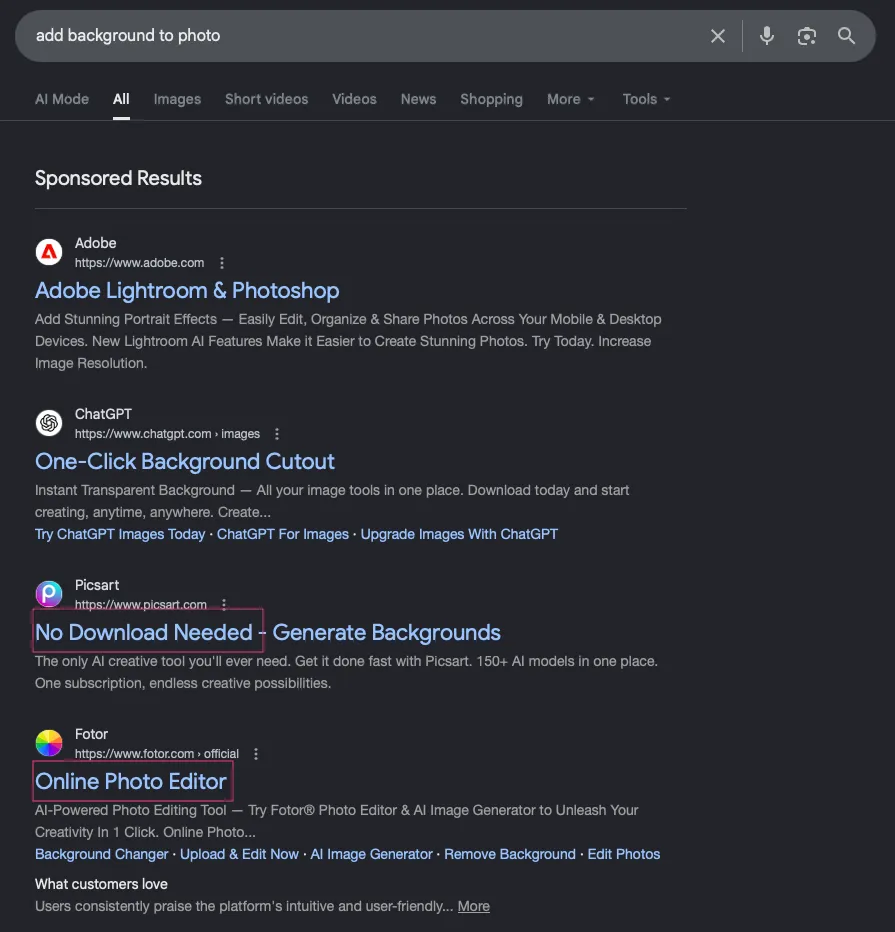
Instead of driving traffic to a download, Adobe is directing it to its new Firefly product online.
Enabling this move to freemium relies on a friction-free experience from online search to an online tool, and the product supports that transition. In 2021, Adobe released a Photoshop web beta, and in 2025, a standalone Firefly app. The Adobe Firefly Pro plan provides full access to the web and mobile versions of Photoshop, but not to the downloaded version.
Driving traffic to a download wouldn’t have been friction-free, and probably not the user that Adobe is attracting for this move. Adobe describes the users as people “looking for Adobe magic to complete a creative task with a friction-free experience,” as distinct from those “seeking to purchase Creative Cloud, Photoshop, and other CC apps” (Wadhwani, Q2 FY26 earnings call, FactSet transcript, p. 6).
Actionable Takeaways
There are some great lessons here from Adobe, and we’ll hear more on how the strategy is going in the upcoming September earnings call.
1. Understand the nuances of your target consumers and potential new customers
Adobe saw a 40% increase in traffic to Adobe.com and noticed the behaviors of this cohort were different. It’s not always easy to tell when you have a unique set of customers. Adobe saw it in the data and likely followed up with qualitative approaches to identify this new “creator” user.
This sounds simple, but I’ve worked on a lot of projects where we had multiple users with different tasks, and it wasn’t clear until we dove into the data and followed up with interviews to understand how different they were. If Adobe had treated the creator user as having the same needs as a graphic designer, they would be selling them the Creative Suite, which is probably overkill for these folks.
2. Revisit and reassess your business often
Recently, I spoke with a founder of a B2B SaaS app. After 8 months, there wasn’t a customer in sight. It’s tempting to want to keep trying the same playbook, hoping it will work. But that means you aren’t iterating on your positioning, sales tactics, or finding the right customer. If a new opportunity presents itself, you can’t go after it because you’re still mired in the same tactics.
Adobe saw an opportunity, was positioned to pursue it, and did so. Even if the tradeoff was underinvesting in current Creative Cloud customers.
Check your business model, run tests and experiments to determine whether you’ve outgrown your approach. If the old way can be improved, plan for changes and execute.
3. Set the product foundation
In 2021, Adobe released a web-based version of Photoshop, which became one of the key product surfaces for its new acquisition strategy. In addition, they invested in their AI products (Firefly) to keep pace with other AI imaging offerings.
It’s hard to predict when a world-shifting technology like AI will arrive. But there are some good practices to keep products flexible. For example, investing in infrastructure, like moving to an API-based architecture or improving data pipelines to enable granular decision-making. Technical debt can slow teams down and prevent them from pursuing new opportunities.
These projects are a tough sell internally because they’re viewed as a cost, and there’s a premium placed on producing customer features. However, building a strong foundation enables greater agility and flexibility to move quickly when the world changes.
Final Thoughts
Adobe’s move away from its traditional paywall was made possible by products already available in the browser. We don’t know for sure if Adobe’s gamble will pay off, but Adobe took some bold bets that they enabled through reading data, observing new user behavior, and amending their business model to accommodate these users.
With the foundations in place, they can execute this new bet. In their upcoming earnings call, we can check in and see how it’s going, but they seem pretty confident and hyper-focused on balancing features in their freemium model.
As Shantanu Narayen said at the June earnings call, “We’re always trying to figure out what we send to the freemium and what we send to ARR.”
References
Adobe Inc. (n.d.). Adobe Firefly plans and pricing. Adobe. https://www.adobe.com/products/firefly/plans.html
Adobe Inc. (n.d.). Free AI PDF summarizer. Adobe Acrobat. Retrieved September 6, 2026, from https://www.adobe.com/acrobat/online/ai-summary-generator.html
Adobe Inc. (2026, June 11). Adobe reports record Q2 results [Press release, Form 8-K Exhibit 99.1]. U.S. Securities and Exchange Commission.
Adobe Inc. (2026, June 11). Q2 2026 earnings call [Corrected transcript]. FactSet CallStreet.
Adobe Inc. (2026, March 25). Form 10-Q for the quarterly period ended February 27, 2026. U.S. Securities and Exchange Commission.
Adobe Inc. (2026, June 11). Adobe investor relations data sheet. Adobe Investor Relations.
Dredge, Stuart. (2014, November 4). Evernote to change premium price as CEO says ‘it was the wrong price’. The Guardian. https://www.theguardian.com/technology/2014/nov/04/evernote-premium-price-phil-libin
Evernote. (2023, November 29). Update: Evernote Free accounts will have fifty notes and one notebook. Evernote Blog. https://evernote.com/blog/evernote-free-note-limits
Li, H. A. (2022). Converting free users to paid subscribers in the SaaS context: The impact of marketing touchpoints, message content, and usage. Production and Operations Management, 31(5), 2185–2203. https://doi.org/10.1111/poms.13672
Lunden, I. (2014, January 21). LogMeIn kills its eponymous free service, uproar ensues. TechCrunch. https://techcrunch.com/2014/01/21/logmein-free/
Poyar, K. (2026, February 4). A new look at free-to-paid conversion: Insights from a survey of 200 software products[Report, in partnership with ChartMogul and ProductLed]. Kyle Poyar’s Growth Unhinged. https://www.growthunhinged.com/p/free-to-paid-conversion-report
Tenebruso, J. (2026, June 12). Why Adobe stock fell today. The Motley Fool. https://www.fool.com/investing/2026/06/12/why-adobe-stock-fell-today/